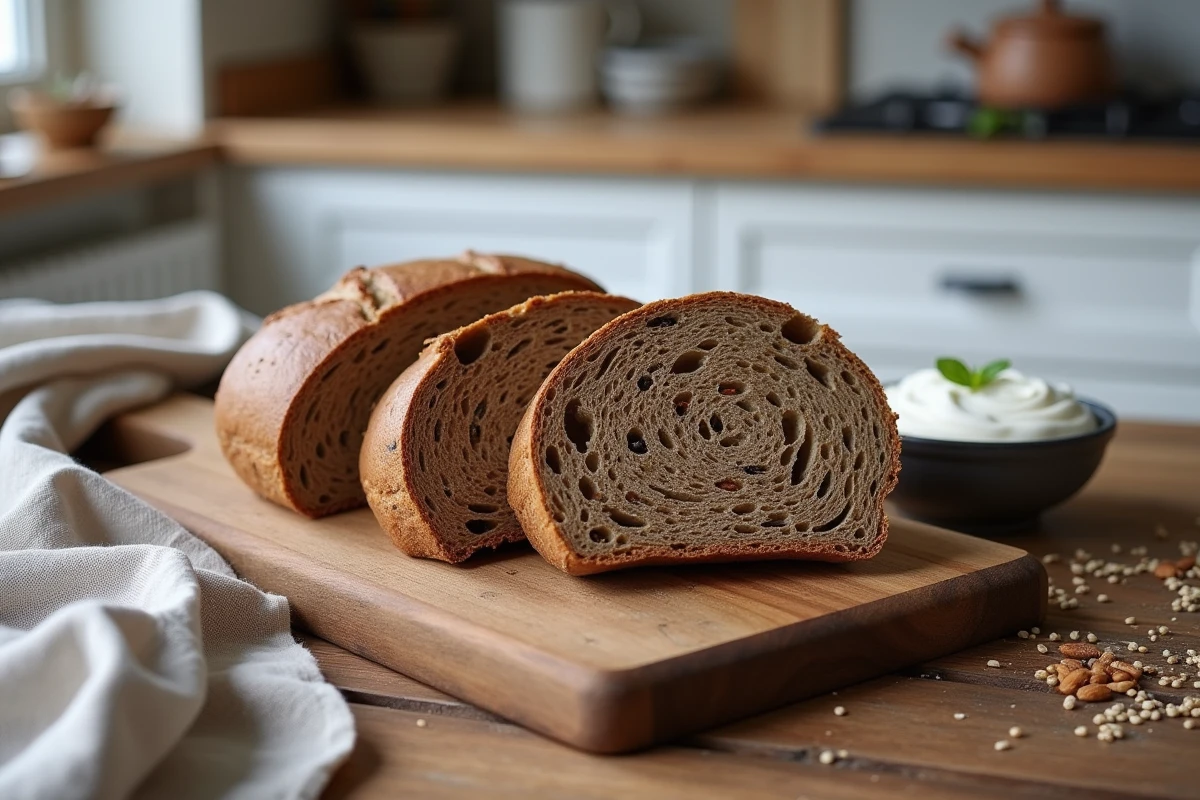
When you turn over a package of Nordic bread in the supermarket, the ingredient list is surprising: rye flour, flax seeds, sunflower seeds, sometimes oats. We are far from the simple white wheat flour of a classic baguette. This mix of cereals and oilseeds alters both the caloric profile, the mouthfeel, and the effect on satiety. Understanding what lies behind the label allows for a truly informed dietary choice.
Oat beta-glucans in Nordic bread: an underutilized health lever
Most product sheets simply list the calories per slice. We overlook a game-changing component: oat beta-glucans. Several manufacturers now incorporate oats or oat flour into their Nordic bread recipes to reach a sufficient level of soluble fiber.
The EFSA has authorized, via regulation (EU) No. 1160/2011, a specific health claim: oat beta-glucans contribute to the reduction of blood cholesterol and the improvement of satiety. This claim is not anecdotal; it is based on controlled clinical studies.
To benefit from this, we check that oat flour or oats are among the first ingredients on the list. The higher a component is on the list, the greater its proportion. A Nordic bread where oats appear in fifth or sixth position will provide only a marginal amount of beta-glucans.
Better understanding the composition and calories of Nordic bread helps identify versions that are truly enriched with soluble fibers and distinguish a marketing product from a nutritionally relevant one.

Calories of Nordic bread compared to baguette and whole grain bread
According to available data on product sheets (Open Food Facts, Fitatu, FatSecret), a slice of Nordic bread weighing about 35 g provides around 85 kcal. For 100 g, it hovers around 243 kcal depending on the brands, with 11 g of protein, 29 g of carbohydrates, and 9 g of fats.
These fats mainly come from the seeds (flax, sunflower, sesame). They are not industrially added fats: the seeds provide unsaturated fatty acids, which changes the nutritional profile compared to brioche or classic sandwich bread.
Quick comparison per 100 g
| Type of bread | Calories (approx.) | Protein | Fiber |
|---|---|---|---|
| Nordic bread (average) | ~243 kcal | ~11 g | High |
| Traditional baguette | ~265 kcal | ~9 g | Low |
| Whole grain bread | ~250 kcal | ~9 g | Medium |
The raw caloric difference is not spectacular. What makes the difference is the density of fiber and protein, which alters the glycemic response and the duration of satiety.
Glycemic index and satiety: what studies show about whole rye
Several intervention studies conducted since 2022 on whole rye bread and breads rich in whole grains confirm a point often overlooked: whole rye bread reduces postprandial blood sugar compared to white wheat bread. It is not just a matter of raw fiber. The intestinal fermentation of rye fibers produces short-chain fatty acids that slow gastric emptying.
In practice, you feel the difference at breakfast. Two slices of Nordic bread with fresh cheese keep you full until noon, whereas two slices of white bread often trigger a hunger pang around 10 a.m. Responses vary among individuals and recipes, but the physiological mechanism is documented.
This benefit is directly linked to the presence of whole rye flour and whole seeds. A Nordic bread primarily formulated with refined wheat flour and a few decorative seeds on the surface will not produce the same effect.

Salt in Nordic bread: significant discrepancies between brands
Salt is rarely discussed in articles about Nordic bread, yet it is a concrete selection criterion. Open Food Facts sheets for different brands reveal notable variability: some Nordic breads meet the PNNS salt reduction guidelines, while others significantly exceed them per 100 g.
To identify the least salty versions, look at the “salt” line in the nutritional table, not the “sodium” line. Salt is sodium multiplied by about 2.5. Here are the points to check on the packaging:
- Salt per 100 g: a well-formulated Nordic bread is below the threshold of 1.2 g of salt per 100 g
- The position of salt in the ingredient list: the lower it is, the better
- The Nutri-Score: a well-balanced Nordic bread generally receives a Nutri-Score A, like the Intermarché product referenced on Open Food Facts
High-protein versions: untangling marketing from true formulations
In recent years, so-called “high-protein” versions of Nordic bread have targeted weight loss diets and bodybuilding. These breads often use pea protein isolates to artificially inflate the displayed protein content.
The result on the label is impressive: some boast over 20 g of protein per 100 g. However, the texture and taste diverge from a true Nordic bread made from rye and seeds. We also lose some of the benefits associated with whole grain fibers, as rye flour is partially replaced by these isolates.
Here are some criteria to distinguish authentic Nordic bread from a reformulated version:
- Rye or whole wheat flours are at the top of the ingredient list, before any protein isolate
- The seeds (flax, sunflower, sesame) are whole ingredients, not extracts
- The fiber content exceeds that of added proteins, indicating a preserved cereal matrix
A classic Nordic bread with its 11 g of natural protein per 100 g already covers a significant portion of breakfast needs without resorting to ultra-processed ingredients. It is better to choose a simple and whole Nordic bread than a version inflated with isolates if the goal is to sustainably improve daily nutrition.