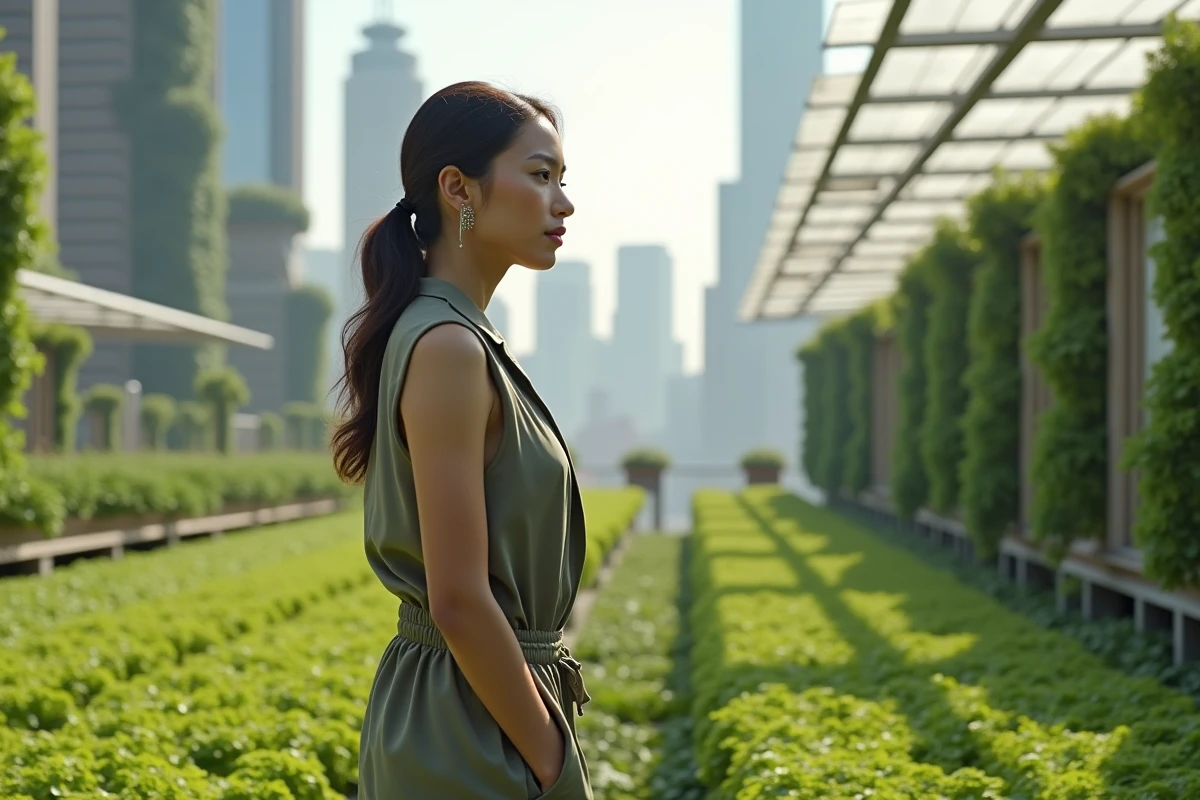
A child born in 2026 will be 24 years old in 2050. Their adult life will begin in a world whose contours largely depend on the decisions made now. Two climate trajectories are emerging for France according to climatologists: a stabilization around +2.7 °C or a drift towards +4 °C by 2100, depending on the level of global emissions in the coming decades.
This generational approach, which involves following the journey of a person born today, helps to make concrete horizons that seem abstract. Rather than listing predictions, let’s focus on three areas where changes are already underway: work, daily climate, and housing.
Offices in 2050: spaces driven by artificial intelligence
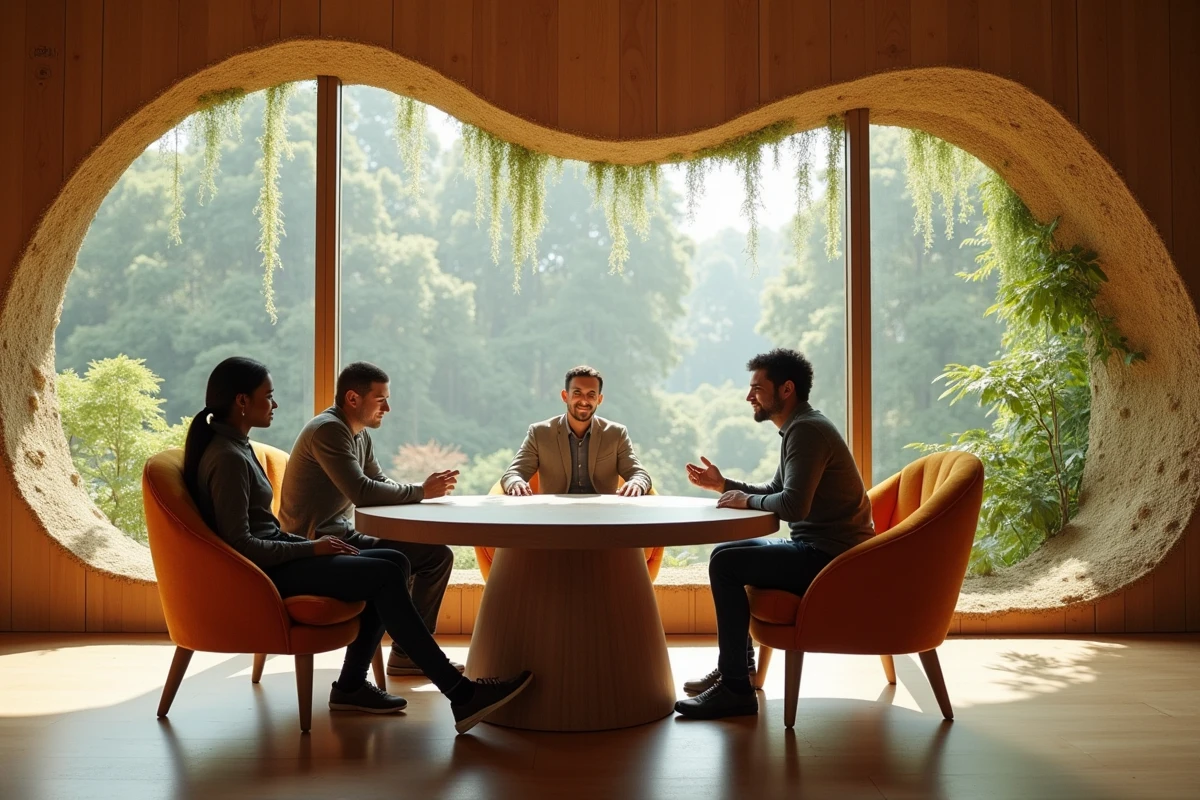
You may have already noticed that your phone adjusts its brightness according to the time? Imagine the same principle applied to an entire building. A study by the IWG group, reported by several French media in 2026, describes offices capable of adjusting lighting to the biological rhythm of each occupant.
The system doesn’t stop at lighting. According to this same study, a strong majority of HR managers and employees anticipate that AI and automation will redefine most office jobs by 2050. Algorithms could determine the best times and places to collaborate, detect fatigue, and recommend breaks.
In practical terms, this means that the office would no longer be a fixed place, but a network of responsive spaces. AI would choose whether you work better at home on Tuesday morning or in a shared space in the afternoon. The role of the employee would evolve: less repetitive execution, more supervision and creativity. Several analysts are also questioning what the world will look like in 2050 when these technologies have matured.
Climate in France by 2050: living with heat as the new norm
The report published by We Demain in 2024 poses a direct question: what will life be like for a child born in 2026? The answer involves a warmer, more unstable world that is more exposed to extreme events.
For France, the difference between the two scenarios (+2.7 °C or +4 °C) is not just a simple thermometer gap. It conditions the frequency of heatwaves, the availability of water in summer, and the viability of certain agricultural crops. Every additional tenth of a degree amplifies the consequences in a nonlinear way.
What this changes in daily life
A resident of southern France in 2050 could experience summers comparable to those of present-day Andalusia. The GEO-7 report from the United Nations Environment Programme (UNEP) confirms this global trend: without radical changes, oppressive heat, species extinctions, and air pollution would worsen everywhere.
UNEP also emphasizes that the worst forecasts can still be avoided if countries act quickly on three fronts:
- Reducing greenhouse gas emissions, targeting the most polluting sectors such as transport and heavy industry
- Preserving biodiversity and soils, whose degradation accelerates warming through a feedback loop
- Managing waste and chemical pollution, which weakens ecosystems and human health long before temperatures rise
As Maarten Kappelle, head of the UNEP science office, summarizes: with a coordinated effort from governments and society, humanity can still turn the situation around.
Housing and cities in 2050: rethinking homes for a transformed climate
Why does this topic deserve special attention? Because buildings are both victims and causes of warming. They consume vast amounts of energy for heating and cooling while directly suffering from heatwaves.
Projections converge towards differently designed housing. Insulation would no longer serve solely to retain heat in winter but to maintain coolness in summer. Bio-based materials, green roofs, and natural ventilation would gradually replace mechanical air conditioning in new constructions.
Urban planning in the face of overheating
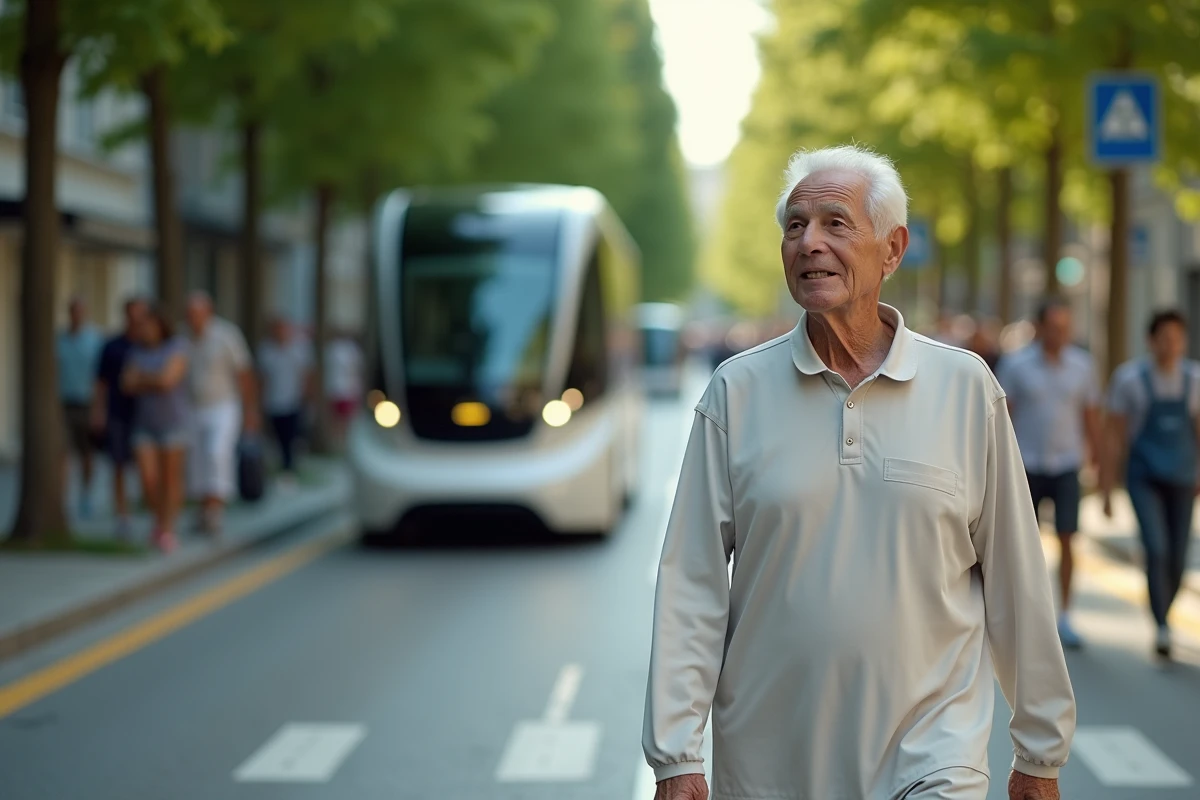
Cities concentrate heat. The urban heat island effect transforms a manageable heatwave in rural areas into a real health hazard in city centers. Urban planning projects aimed at 2050 now incorporate soil de-sealing, the creation of cool corridors, and the return of vegetation to open ground.
Building for 2050 requires anticipating a climate that does not yet exist locally. Architects and urban planners work with projected climate data, not historical records. This is a profound methodological change that also affects building standards and local urban planning regulations.
Two trajectories, one temporal horizon
The world in 2050 will not be uniform. Depending on the collective choices made in the coming years, daily life could oscillate between two very different realities. In a scenario of coordinated transition, smart offices will enhance productivity, housing will be adapted to new temperatures, and ecosystems will have been partially preserved.
In a scenario of prolonged inaction, the same technologies will exist, but they will mainly serve to compensate for damage: air-conditioning suffocating cities rather than having designed them differently. The difference between these two futures does not lie in the available technology, but in the speed of political and economic decisions made by then.
The horizon of 2050 remains close enough for the choices of this decade to shape its contours. And far enough that almost everything is still negotiable.