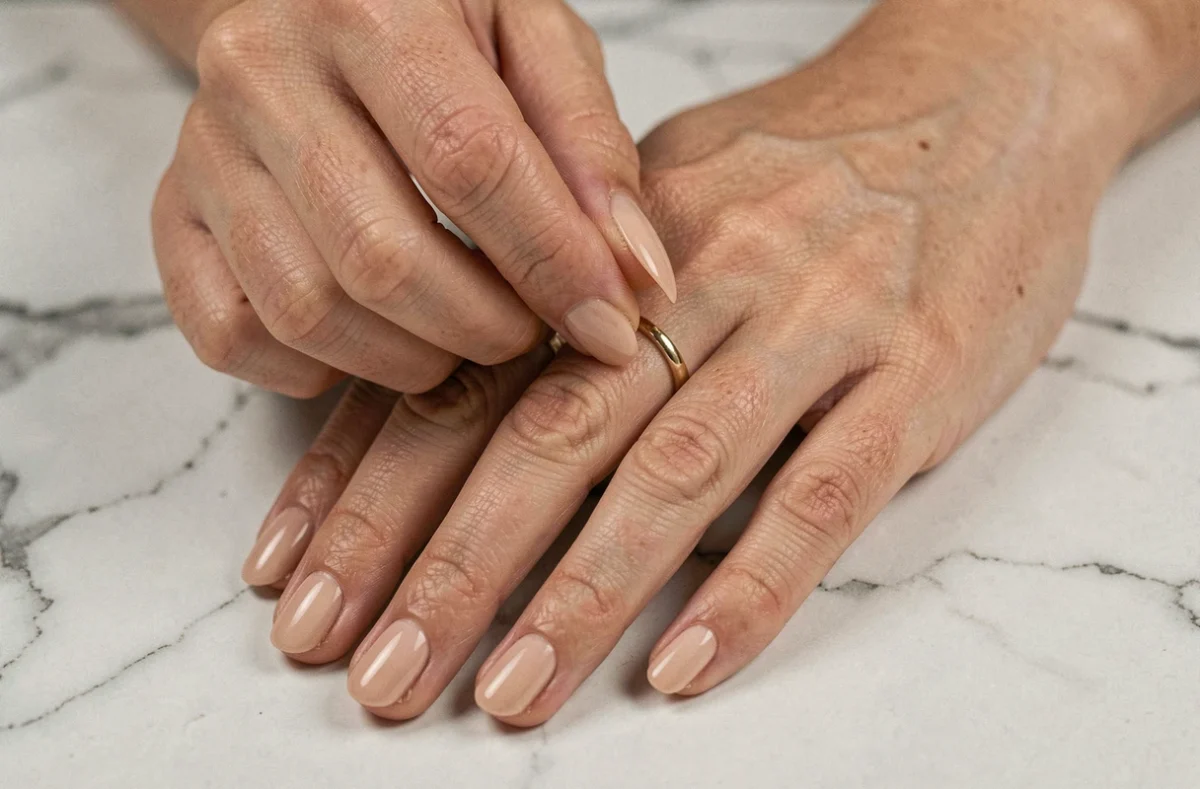
Each finger has its own anatomy, diameter, and mobility. Wearing a ring on the right finger is primarily a matter of mechanical fit between the band, the joint, and the base of the finger, even before considering symbolism or style. The choice of finger for wearing a ring determines daily comfort, the longevity of the jewelry, and visual harmony with the hand.
Ring Width and Finger Choice: The Often Overlooked Technical Criterion
Most guides focus on the symbolism of each finger. However, the first parameter to consider is physical: the width of the ring alters the perceived size. A wide ring covers more skin surface and exerts pressure differently than a thin band. On the same finger, a model several millimeters wide will feel tighter than a thin ring of the same size.
This phenomenon has a direct consequence on finger choice. A wide band is better suited for a fleshy finger (thumb, middle finger) where the contact surface remains proportionate. On a narrower pinky or index finger, the same width can hinder joint flexion.
For a wide model, some measurement recommendations suggest choosing a half size or even a larger size. This is not just an aesthetic detail: it’s an adjustment constraint that should be verified finger by finger, as each phalanx reacts differently to the pressure of a wide band. By consulting Madame Pervenche’s tips, one can find this logic of adaptation between the shape of the jewelry and the morphology of each finger.
Ring Size: Measure on the Right Finger, at the Right Time
The size must be checked on the finger actually chosen, and not transposed from one hand to another. The dominant hand often has a slightly larger volume than the other, which can distort a fit if the measurement was taken on the wrong hand.
Beyond the hand, the timing of the measurement is as important as the method. Finger swelling varies with heat, cold, physical activity, salt intake, and the time of day. A reliable measurement should be taken under these conditions:
- At rest, without recent physical exertion or prolonged exposure to cold or heat
- At room temperature, preferably at the end of the day when fingers reach their maximum volume
- Multiple times on different days to confirm the consistency of the result
Passing the Joint, Not Just the Base
The decisive practical criterion is often misunderstood. A properly fitted ring passes over the joint with slight resistance, then can be removed with a gentle pull. Measuring only the circumference of the base of the finger can lead to a ring that is impossible to remove when the finger swells, or conversely too loose when it retracts in cold weather.
This point is particularly sensitive for the ring and middle fingers, whose joints are often more pronounced than those of the thumb or pinky. The difference in diameter between the base and the knuckle can be notably significant in some hand morphologies.
Thumb, Index, or Pinky Ring: Adapting Style to the Finger
Once the technical constraint is established, the choice of finger guides the style. Not all fingers accommodate the same ring shapes with equal ease.
The thumb is the most mobile and thickest finger. It handles wide bands, thick signet rings, and geometric models well. Its position away from the other fingers prevents friction, making it a comfortable spot for bulky rings worn daily.
The index is constantly exposed, making it a prime location for a ring that one wishes to be visible. Models with prominent stones or designer rings find good visibility here. The constraint: the index is heavily used in gripping actions. An overly bulky ring can hinder the manipulation of fine objects.
The middle finger, being the central and longest finger, offers a natural visual balance. A simple ring on the middle finger structures the hand without drawing excessive attention. Its robustness allows for the wearing of medium-width bands without notable discomfort.
The pinky traditionally hosts signet rings and signature rings. Its slenderness necessitates narrow or small-sized models. A ring that is too heavy on the pinky easily tips and irritates the skin between the fingers.

Wedding Band and Ring Finger: A Convention, Not an Obligation
The left ring finger remains associated with the wedding band in French tradition and in most Western countries. This convention dates back to the Roman belief that a vein, the vena amoris, directly connected this finger to the heart. The symbolism of the ring finger for love and commitment persists in current social codes, even though it has no anatomical basis.
In other traditions (Germany, Russia, India, Scandinavian countries), the wedding band is worn on the right hand. The choice between the right and left hand is therefore a cultural practice, not a universal rule.
Stacking Rings on the Same Finger
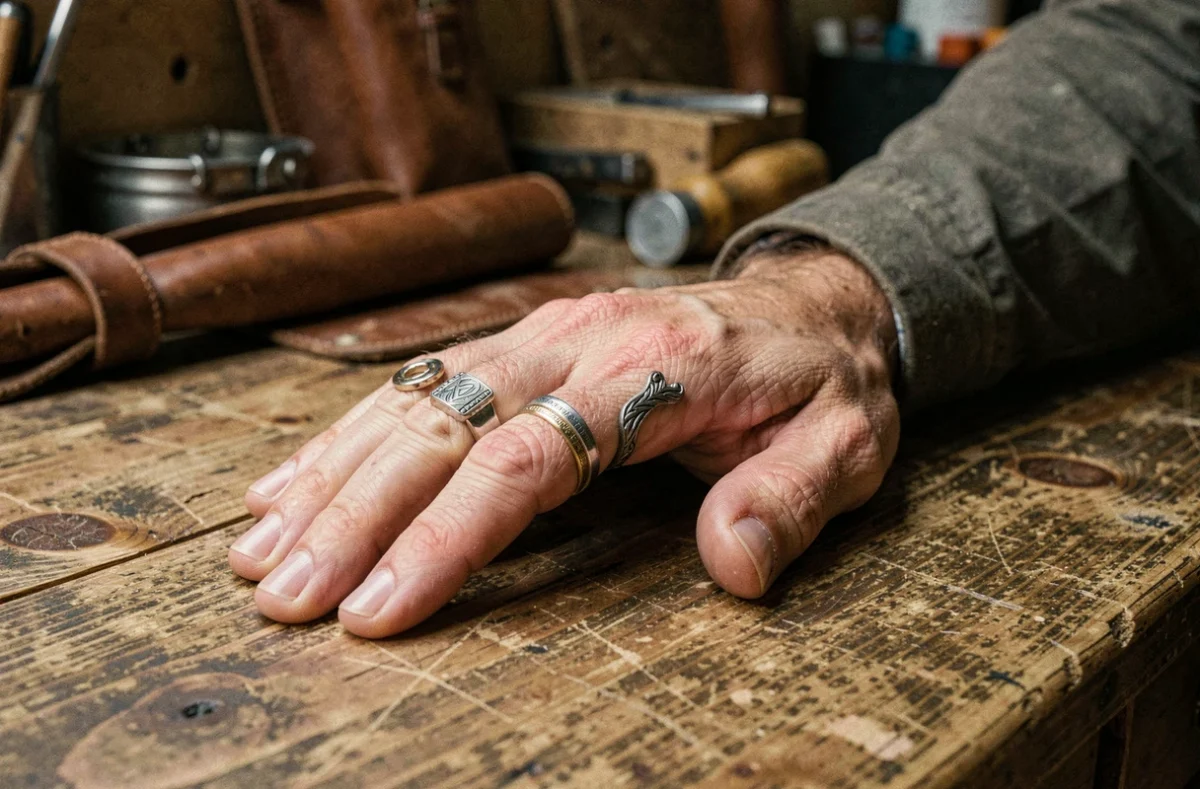
Stacking rings on the ring or middle finger has become common. This practice works as long as a simple rule is followed: stacked rings should not extend beyond the first knuckle. Beyond that, they limit finger flexion and rub against each other.
- Prefer thin bands (a few millimeters wide) to maintain mobility
- Alternate smooth and textured finishes to create visual contrast without overcrowding
- Ensure that the size of each ring accounts for the added volume from adjacent rings
Ring and Sensitive Skin: Metal Varies by Finger
Friction areas vary from finger to finger. The space between the ring and middle fingers, for example, is an area where sweat stagnates and nickel reactions manifest more quickly. For sensitive skin, the choice of metal must adapt to the targeted finger.
The most tolerated metals remain gold (9 or 18 carats), platinum, and recycled 925 silver. Alloys containing nickel, lead, or cadmium are regulated by REACH in Europe, with strict migration thresholds. A piece of jewelry compliant with REACH thresholds does not guarantee the absence of reactions on particularly reactive skin, especially in areas of prolonged friction such as the base of the ring finger under a wedding band worn continuously.
The finger chosen to wear a ring results from a balance between morphology, mechanical comfort, and stylistic intention. Symbolism guides the initial choice, but it is the width of the band, the measurement of the joint, and skin tolerance that determine whether the ring will actually be worn daily.