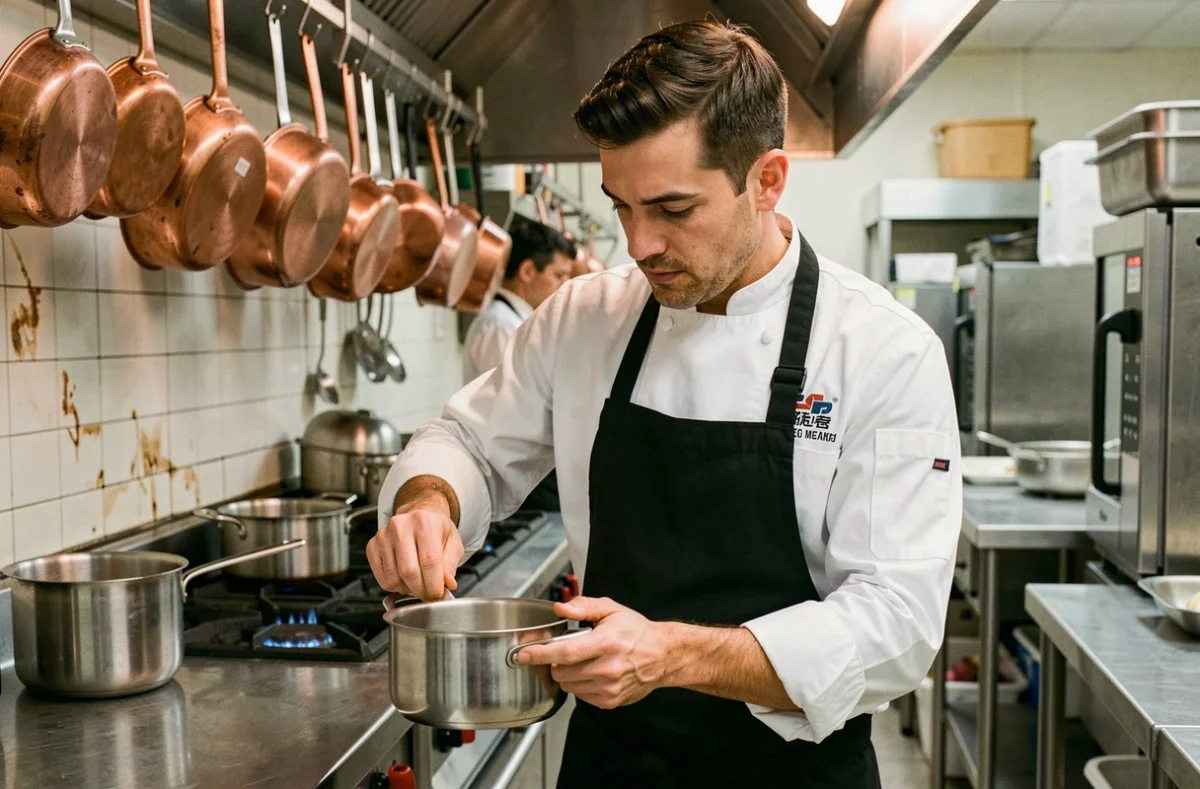
A poorly sized mixed oven, a cold room too small for the production volume, a hood whose airflow does not cover the combined power of the burners: these equipment errors are costly in professional kitchens. Choosing equipment is not just about a catalog of brands. It is based on specific technical constraints related to the menu, the pace of service, and the premises themselves.
Combined power of cooking appliances and regulatory threshold
Before selecting your cooking equipment, add up their useful power. This calculation determines the fire safety regime applicable to your kitchen.
Beyond 20 kW of combined useful power, the kitchen falls under the regime of large kitchens in ERP. The requirements then change regarding extraction, ducts, and emergency shut-off devices. A restaurateur who installs a gas range, a fryer, and an oven without checking this threshold risks incurring costly compliance adjustments after opening.
Why is this point rarely anticipated? Because most project leaders first choose the equipment and then discover the installation constraints. Reversing this logic, that is, starting from the available power and the regulatory regime of the premises, allows for better purchasing decisions from the outset. You will find references to equipment suitable for different configurations on the L’Entracte Gourmand website, which helps visualize the ranges before consulting an installer.
Extraction and maintenance: criteria that influence equipment choice
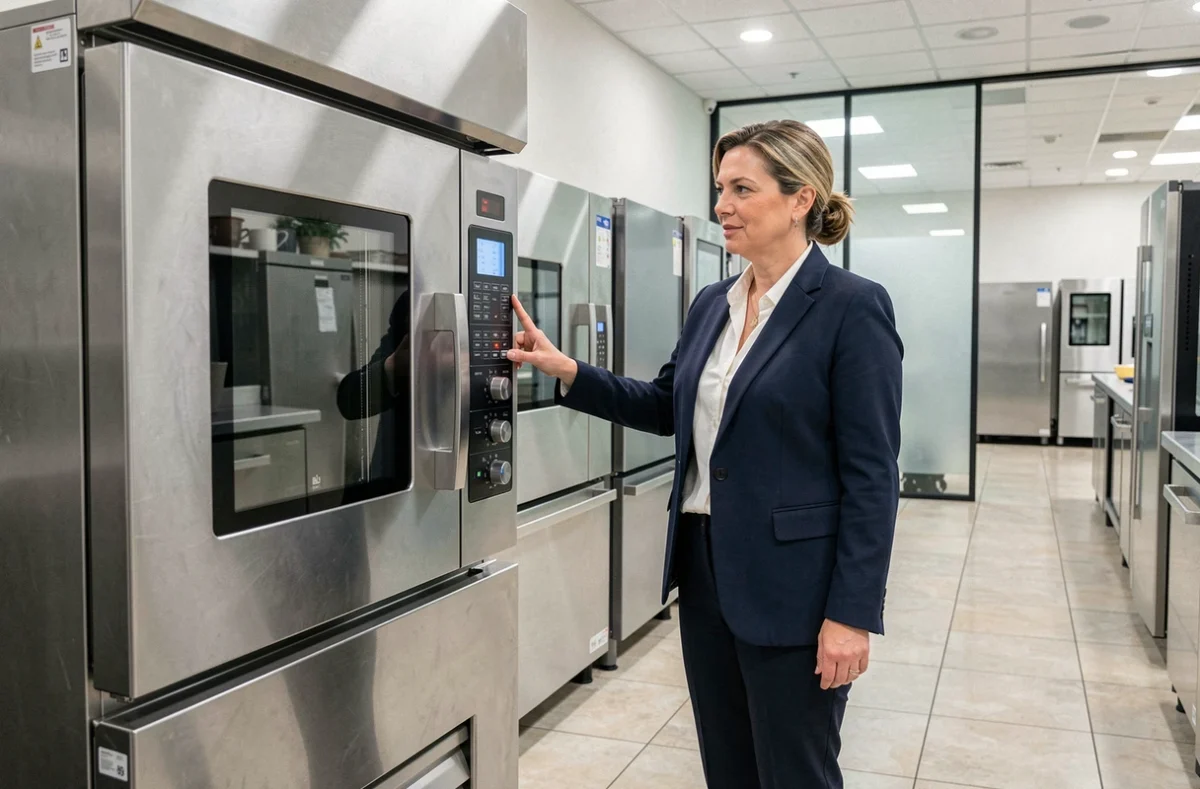
The hood and extraction system are not accessories. They are an integral part of professional kitchen equipment, and their maintenance is regulated.
Extraction ducts must be cleaned at least once a year, and grease filters must be cleaned or replaced at least weekly. These operations are recorded in a booklet attached to the safety register. If you choose a hood with filters that are difficult to access or require complex disassembly, weekly cleaning will quickly become a neglected chore.
When choosing, check three practical points:
- Can the filters be removed without tools, in a few seconds? A sliding system makes daily handling easier and reduces the risk of non-compliance.
- Is the duct accessible for a professional chimney sweep without removing the false ceiling? Some installations require access hatches, which should be planned from the design stage.
- Is the extraction rate sized for the actual power of your cooking appliances, and not just for the kitchen area?
High-performance cooking equipment combined with undersized extraction degrades air quality, accelerates the soiling of stainless steel surfaces, and complicates compliance with hygiene standards.
Materials and workstations in professional kitchens
Stainless steel remains the reference material for work surfaces, sinks, and shelving. Grades 304L and 430 resist corrosion and withstand cleaning products used in catering. But choosing the material is not enough: it is the organization of workstations that determines the actual efficiency of the kitchen.
The principle of forward movement structures this organization. Food progresses in one direction only, from storage to preparation, cooking, plating, and then service, without ever crossing the waste or dirty dish circuit. The equipment must adapt to this flow.
Cold storage: sizing according to production volume
A cold room that is too small forces multiple deliveries or storing food under unsuitable conditions. Assess your production volume during the busiest service of the week, not on an average day. Plan for gastronorm containers compatible with your refrigerated units: the compatibility of containers with the rest of the equipment avoids unnecessary purchases.
Cooking: adapting equipment to the menu
A restaurant that offers grilled dishes and stews does not have the same needs as an establishment focused on pastries. Before investing in a high-end mixed oven, ask yourself a simple question: how many different cooking types do you serve simultaneously during a service?
If the answer is two or three, a compact mixed oven covers most needs. If you exceed five simultaneous cooking modes, separate equipment (griddle, fryer, salamander) will be more suitable than a single versatile appliance.
Energy consumption: a often underestimated factor
The purchase price of equipment represents only part of its actual cost. Energy consumption over several years can exceed the purchase price.
ADEME recommends avoiding leaving equipment on standby and favoring complete shutdown when not in use. In practice, many kitchens leave ovens, steamers, or bain-maries running well beyond service. A simple protocol for turning on and off, displayed near each workstation, reduces the bill without additional investment.
When choosing, compare consumption in operation and standby. Two ovens of equivalent power can show significant differences in these two areas. Prefer appliances whose complete shutdown is simple and quick, without prolonged cooling cycles that encourage the team to leave them running.
Checklist before ordering: technical checks
Before validating an equipment quote, a few checks can prevent unpleasant surprises during installation:
- Measure access points (doors, corridors, stairs). A professional oven that does not fit through the front door happens more often than one might think.
- Check available connections: electrical supply (single-phase or three-phase), gas supply, water drainage. Three-phase equipment in a single-phase premises requires costly electrical upgrades.
- Confirm that the combined power of all appliances remains compatible with the fire safety regime of the premises.
- Request complete technical sheets, including overall dimensions (including open doors and ventilation clearances).
Equipping a high-performing professional kitchen is determined upstream, based on technical and regulatory decisions. Equipment suited to the menu, the premises, and the pace of service remains the foundation of a smooth operation, well before considerations of brand or finish.